
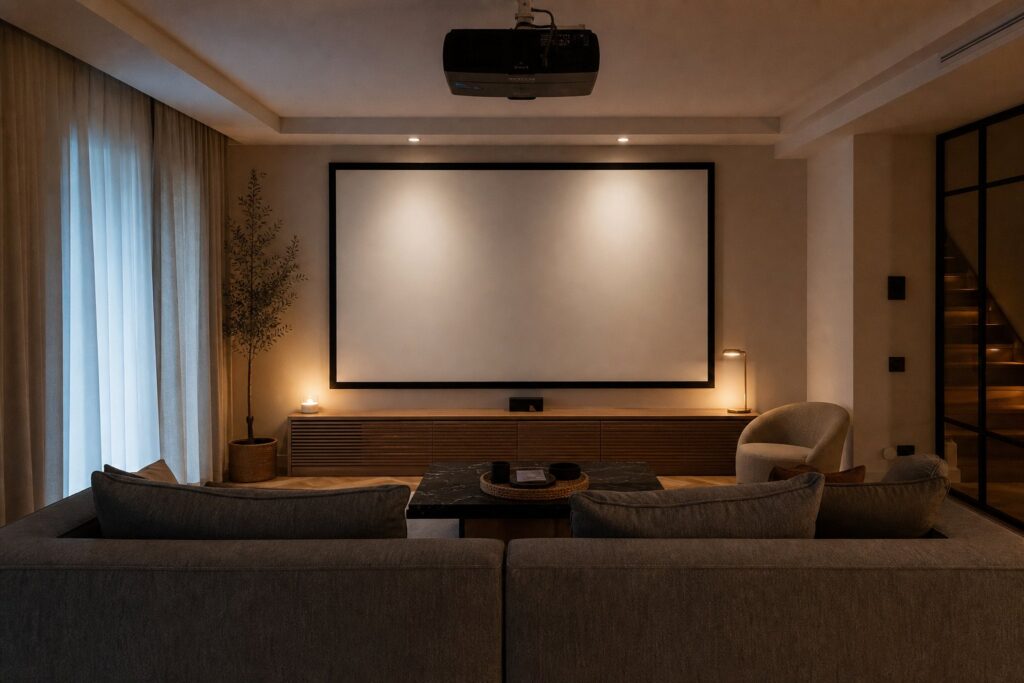
In the world of projection, “Gain” is a measurement of the reflectivity of a screen’s surface. A gain of 1.0 is the industry baseline—it means the screen reflects light equally in all directions, just like a flat white wall.
If a screen has a gain of 1.5, it reflects 50% more light toward the viewer than a 1.0 screen. If it has 0.8, it absorbs some light to improve black levels. Choosing the wrong one can lead to a washed-out image or a “hot spot” in the center of your movie.
1. High Gain Screens (1.3 to 2.0+)
These screens are designed to “boost” the brightness of your projector. They use special coatings (often glass beads or pearlescent layers) to focus light back toward the seating area.
- Best for: Low-lumen projectors (older lamp models) or very large screens (150″+) where the light has to be spread over a massive area.
- The Downside: High gain reduces the “viewing angle.” If you sit too far to the side, the image will look significantly dimmer. You may also notice “hot spotting,” where the middle of the screen looks much brighter than the edges.
2. Standard / Neutral Gain (1.0 to 1.1)
This is the “safe bet” for most dedicated home cinemas.
- Best for: Rooms with total light control (blackout curtains, dark paint).
- The Benefit: 1.0 gain screens offer the most natural color reproduction and the widest possible viewing angles. Everyone in the room gets the same high-quality experience, whether they are on the floor or the far end of the couch.
3. Negative / Low Gain (0.6 to 0.9)
Often called “Gray Screens” or “High Contrast” screens, these are becoming incredibly popular in 2026.
- Best for: High-brightness 4K Laser projectors. Modern lasers are so bright that they can sometimes make “blacks” look dark gray. A 0.8 gain screen “soaks up” that excess light, making black levels look deeper and inkier.
- The Benefit: These screens are excellent at rejecting a small amount of ambient light, making them perfect for living rooms that aren’t 100% dark.
The “Screen Gain” Cheat Sheet
| Room Type | Projector Type | Recommended Gain |
| Dedicated Dark Theater | Standard 4K Projector | 1.0 to 1.1 (White) |
| Living Room (Some Light) | High-Lumen Laser | 0.8 to 0.9 (Gray/ALR) |
| Very Large Screen (150″+) | Mid-Range Brightness | 1.3 to 1.5 (Pearlescent) |
| Ultra Short Throw (UST) | Any Laser TV | 0.5 to 0.8 (CLR/Specialty) |
3 Golden Rules for Choosing Gain
Rule 1: Consider Your Walls
If your room has white walls and a white ceiling, light from the screen will bounce off the walls and back onto the screen, washing out the image. In this case, a lower gain (0.8) or an ALR (Ambient Light Rejection) screen is mandatory to preserve contrast.
Rule 2: Check Your Projector’s “Lumens”
In 2026, many laser projectors pump out 3,000+ lumens. On a standard 100-inch screen, a 1.5 high-gain screen would actually be too bright, causing eye fatigue. If your projector is a “light cannon,” stay at 1.0 or lower.
Rule 3: The Viewing Cone
Before buying a high-gain screen (1.3+), measure your seating arrangement. If you have a wide sectional sofa where people sit at sharp angles to the screen, a high-gain surface will result in a poor experience for those on the edges. Stick to 1.0 gain for wide seating.
The 2026 Verdict
For the average user buying a modern 4K laser projector today, a 0.9 to 1.1 gain screen is the sweet spot. It provides the best balance of color accuracy, contrast, and viewing angles without the technical headaches of specialty high-gain surfaces.
Image created with AI for illustrative purposes.