
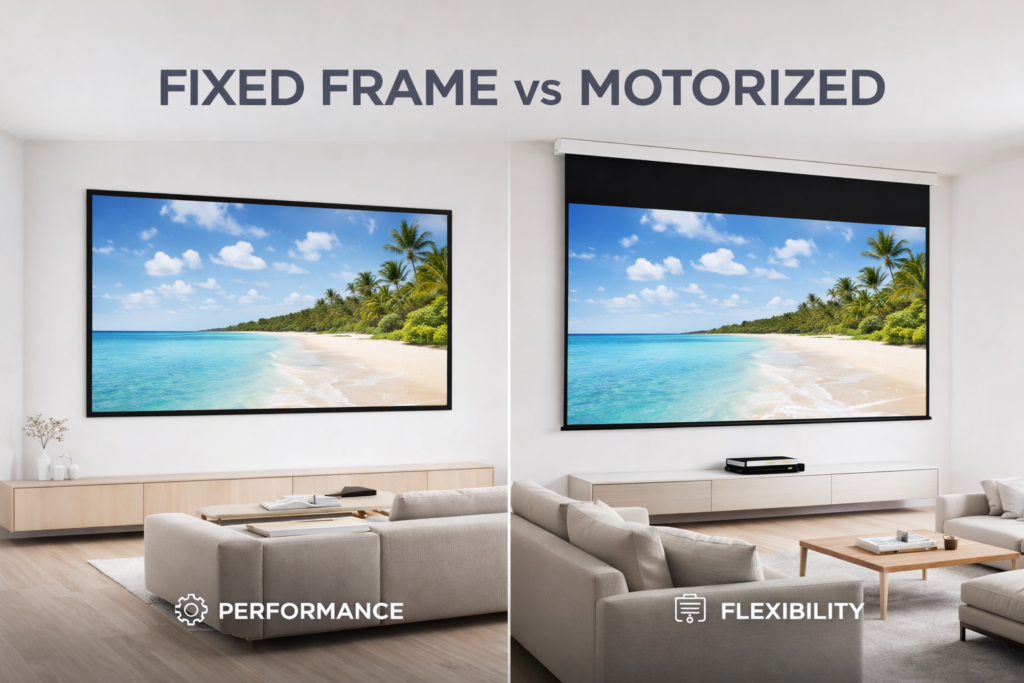
Introduction (Decision Trigger)
At some point, every buyer faces this question:
Should you go for a fixed frame screen or a motorized (electric) screen?
This is not just about aesthetics—it directly impacts:
- Image quality
- Usability
- Long-term satisfaction
1. Fixed Frame Screens (Performance First)
Best for:
- Dedicated home cinema rooms
- Users prioritizing image quality
- Permanent installations
Advantages:
- Perfect flatness (no waves or distortion)
- Highest image precision
- Best for high-end projectors and 4K content
Limitations:
- Always visible (not retractable)
- Requires dedicated wall space
Positioning:
The benchmark for performance-driven setups.
2. Motorized Screens (Flexibility & Design)
Best for:
- Living rooms
- Multi-purpose spaces
- Clean interior design setups
Advantages:
- Retractable (hidden when not in use)
- Remote or smart-home control
- Ideal for modern interiors
Limitations:
- Slight risk of edge waves over time
- Typically higher cost
- Installation more complex
Positioning:
The best choice for flexible, lifestyle-oriented setups.
Direct Comparison
| Feature | Fixed Frame | Motorized |
|---|---|---|
| Image Flatness | ✔️✔️✔️ | ✔️✔️ |
| Aesthetic Flexibility | ❌ | ✔️✔️✔️ |
| Installation | Medium | Complex |
| Durability | High | Medium |
| Price | €€ | €€€ |
Key Decision Factors
Choose Fixed Frame if:
- You have a dedicated room
- You want maximum image quality
- You don’t need to hide the screen
Choose Motorized if:
- The room serves multiple purposes
- You care about interior design
- You want a clean, hidden solution
Critical Insight (Buyer Psychology)
Many buyers choose motorized screens for design reasons—
but later regret sacrificing image precision.
If performance is your priority → fixed frame wins.
Strategic Recommendation
- Home cinema room → Fixed Frame
- Living room setup → Motorized Screen